| Sign In | Join Free | My entremaqueros.com |
|
Model Number : J-SAP-JBF4121A
Bus Voltage : DC 14V ~ DC 24V
Alarm Concentration : 0.65~15.5%FT
MOQ : 100 set system
Delivery Time : 15-20days
Minimum Oeder Quantity : 1set
Maintenance : Monthly Testing Recommended
Power : Battery
Certification : CCC;GB/T 3836.1-2021;GB/T 3836.4-2021;GB 19880-2005
Packaging Details : Wooden Box Or Plywood Outer Box With Bubble Bag Or Paper
Payment Terms : T/T,L/C
Temperature : -10℃ to +55℃
Working Voltage : DC19-28V
Light Intensity : 135cd
Brand Name : XINGJIN
Indicated Light : Red (Alarm/Failed), Green (Running)
Place of Origin : Guangzhou,China
Operatingtemperaturerange : -10°C to 50°C
Price : USD3-4/pc
Installation : Wall mounting
Nominal Diameter : 15mm, 20mm
Power Voltage : DC 24V
Supply Ability : 300000 sets per month
Poe : Optional
Usage : Fire alarm display and alarming
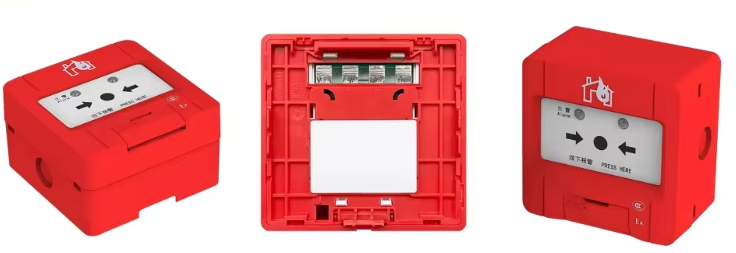
The J-SAP-JBF4121A-Ex is a microprocessor-based, intrinsically safe manual fire alarm button engineered for hazardous areas that require explosion-proof protection. It connects to addressable fire alarm control panels through a non-polarised two-bus system, delivering dependable manual alarm initiation with low power consumption and an extended communication range.
Built around a dedicated microprocessor, the device ensures stable performance and fast response. SMT surface-mount technology enhances reliability and product consistency across all units.
The unit operates on a non-polarised two-bus system, eliminating the need to distinguish between positive and negative terminals during wiring. This simplifies installation, reduces the risk of connection errors, and supports communication distances of up to 1000 metres while maintaining low current consumption.
The device is of intrinsically safe type and must be used in conjunction with a certified safety barrier. It is suitable for installation in hazardous environments where explosive gases or vapours may be present.
Address assignment is carried out using a dedicated electronic encoder, enabling fast and accurate on-site configuration. The coding method supports straightforward system commissioning and re-addressing when required.
To activate an alarm, the operator presses the front panel. The button mechanism is designed for ease of use, ensuring quick manual fire reporting. After activation, the panel can only be reset using the matching special key, preventing unauthorised or accidental reset.
The unit features a plug-in mechanical design, allowing the button assembly to be easily inserted into or removed from its base. This simplifies initial installation, routine maintenance, and future replacement, reducing on-site labour time and effort.
| Operating Temperature | -10 to +55°C |
| Storage Temperature | -30 to +75°C |
| Relative Humidity | ≤ 95% RH (40 ± 2°C) |
| Parameter | Technical Specification |
|---|---|
| Operating Voltage | DC 18–28V, modulated type provided by controller (must use safety barrier) |
| Standby Current | ≤ 0.3mA (24V) |
| Alarm Current | ≤ 1mA (24V) |
| Explosion-Proof Mark | Ex ib IIC T6 Gb |
| Addressing Method | Electronic encoder addressing |
| Addressing Range | 1–200 |
| Indicator Light | Fire indicator flashes momentarily in standby mode; stays steady red when pressed and in alarm |
| Dimensions | 90mm (L) × 90mm (W) × 52mm (H) |
| Wiring System | Two-wire bus, non-polarity |
|
|
Intrinsically Safe Explosion-Proof Manual Fire Alarm Button with Non-Polarised Two-Bus and Microprocessor-Based Fire Alarm Push Button Station Images |